Weekly Tips!
How Climate Change Is Reshaping High-Tech Greenhouse Production
Climate change is transforming agriculture across the world, making crop production less predictable and more challenging. Extreme weather events, prolonged droughts, water shortages, and changing growing seasons are forcing growers to rethink how food is produced. As a result, high-tech greenhouses are becoming an increasingly important solution for producing consistent, high-quality crops throughout the year.
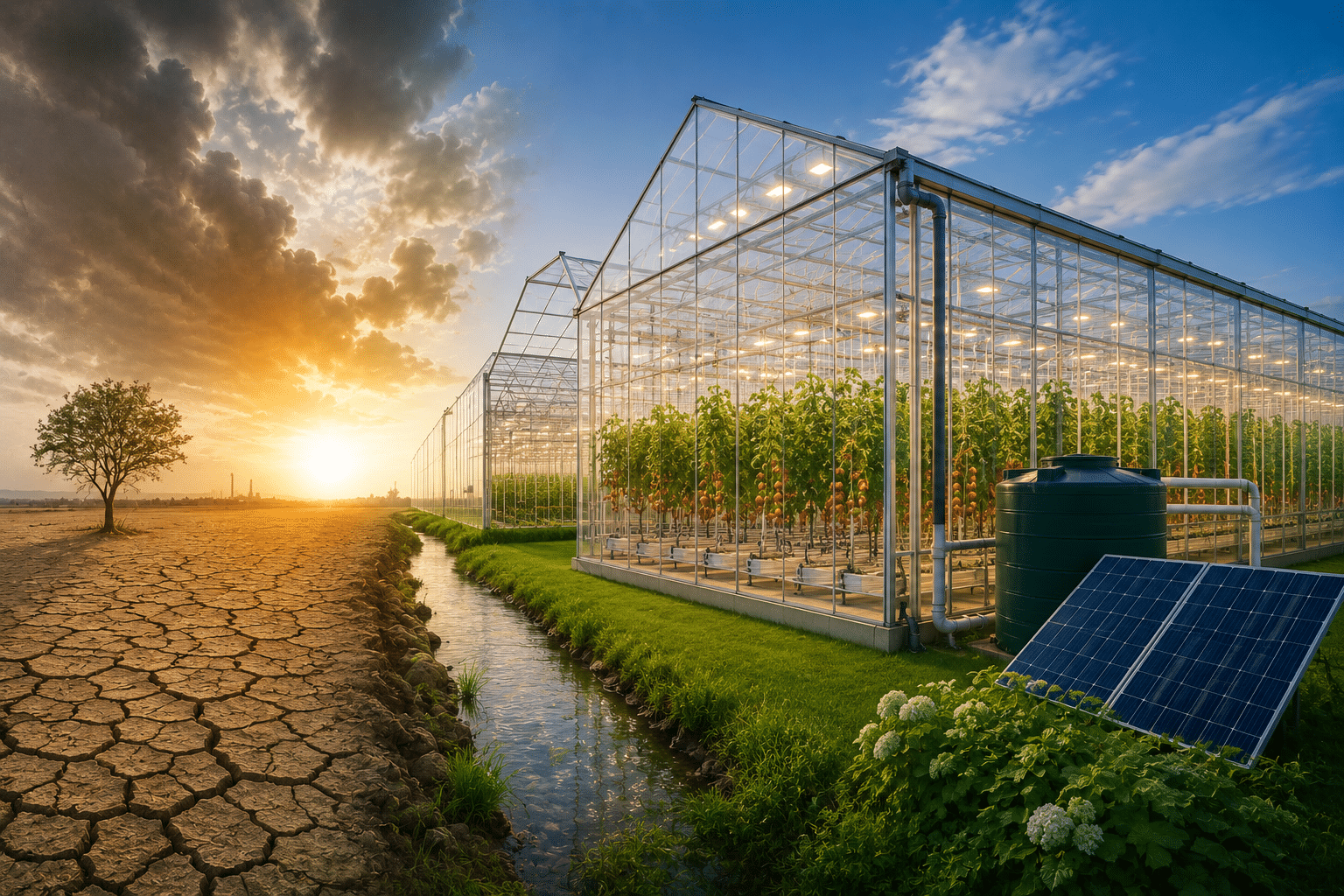
Why is climate change affecting traditional agriculture?
Climate change is increasing the frequency of extreme weather conditions, making open-field farming more difficult and less predictable.
Growers are increasingly facing:
- Longer periods of drought
- Heavy rainfall and flooding
- Heatwaves
- Unexpected frost
- Changing pest and disease pressure
These challenges can significantly reduce crop yields and affect product quality.
“The weather has always influenced agriculture. Climate change is making it increasingly unpredictable.”
Why are high-tech greenhouses becoming more important?
High-tech greenhouses offer growers the ability to control the growing environment instead of depending on the weather.
Modern greenhouse technology enables:
- Precise climate control
- Year-round production
- Efficient water use
- Reduced pest pressure
- Consistent crop quality
Controlled Environment Agriculture (CEA) allows growers to produce food under stable conditions, regardless of external weather extremes.
“The future of food production depends less on the weather and more on technology.”
How does climate control improve crop production?
Climate control allows growers to create optimal growing conditions throughout the entire production cycle.
Using advanced climate computers and automation systems, growers can regulate:
- Temperature
- Humidity
- CO₂ levels
- Ventilation
- Light intensity
This results in:
- Higher yields
- Better quality
- More predictable production
- Lower production risks
“Control creates consistency, and consistency creates profitability.”
Why is water management becoming a competitive advantage?
Water is becoming one of the world’s most valuable agricultural resources.
High-tech greenhouses use advanced irrigation systems that dramatically reduce water consumption compared to traditional farming.
Many modern facilities also use:
- Rainwater harvesting
- Closed-loop irrigation systems
- Water recirculation
- Precision fertigation
These technologies help growers maximize every litre of water.
“Tomorrow’s most valuable greenhouse resource may not be land—it may be water.”
How is climate change influencing investment in greenhouses?
Governments, investors, and food producers are increasingly investing in controlled environment agriculture to improve food security.
Investment drivers include:
- Population growth
- Food security concerns
- Sustainability goals
- Reduced dependence on imports
- Climate resilience
Across Europe, North America, and the Middle East, large-scale greenhouse projects continue to expand as demand for reliable food production increases.
“Climate resilience is becoming one of the strongest drivers of greenhouse investment.”
What skills will greenhouse companies need in the future?
As greenhouse technology continues to evolve, demand for highly skilled professionals will continue to increase.
Future greenhouse operations require professionals with expertise in:
- Climate control
- Crop steering
- Irrigation management
- Data analysis
- Greenhouse automation
- AI-supported growing systems
Technology alone is not enough—experienced people remain essential to maximize production.
“The greenhouse of the future will be powered by technology, but operated by highly skilled people.”
FAQ Introduction
These frequently asked questions explain how climate change is influencing greenhouse production around the world.
Because they provide stable growing conditions despite increasingly unpredictable weather.
Water scarcity is increasing globally, making efficient irrigation essential for future food production.
Yes. Many governments and investors see controlled environment agriculture as a long-term solution for food security.
Absolutely. As technology advances, experienced growers and technical specialists will play an even greater role in maximizing greenhouse performance.
Internal Link Suggestions
- “What Does a High-Tech Grower Actually Do?”
- “Why Data-Driven Growing Is the Future of CEA Recruitment”
- “How Talent Shortages Delay Greenhouse Expansion Projects”
- “How the Wars in Ukraine and Iran Are Impacting Greenhouse Vegetable Prices”
Conclusion
Climate change is fundamentally changing the future of agriculture. While traditional farming faces increasing uncertainty, high-tech greenhouse production offers a reliable and sustainable alternative for producing fresh food year-round. Companies that invest in technology, efficient resource management, and skilled professionals will be best positioned to meet the growing global demand for food. As climate challenges continue to grow, controlled environment agriculture will become an increasingly important part of the world’s food system.
Building better teams, driving better careers.
Success is built on the right connections. Whether you are scaling your organization with top-tier talent or looking for a career-defining new challenge, we provide the expertise and network to make it happen. Let’s discuss how we can support your growth and help you navigate today’s competitive market.